

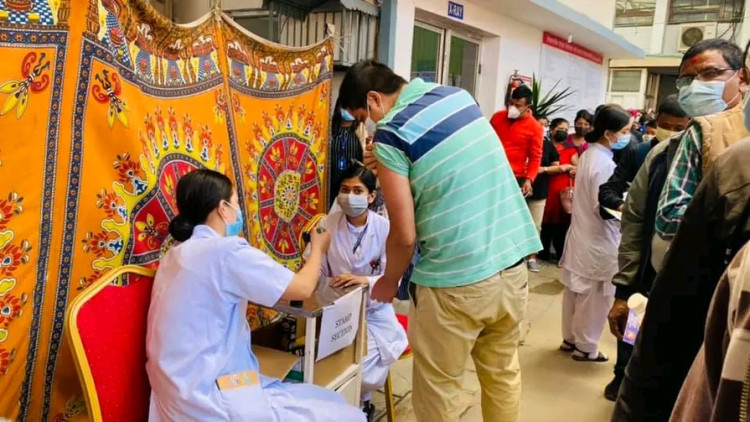
The Certificate in General Medicine (Health Assistant) is a vital three-year CTEVT program for SEE graduates. It trains mid-level professionals to provide primary healthcare, especially in rural Nepal.
The curriculum shifts from basic sciences to intensive clinical practice, covering surgery, pediatrics, and emergency care. Graduates serve as Health Assistants (HAs) in government and private institutions, with pathways to further studies in Public Health and MBBS.
General Medicine Graduate having established career goals and refined clinical competency can seek further education which will strengthen their professional image challenge their scholastic abilities and prepare them for undergrad school.
The first year focuses on general basic science while the second and third year is purely applied science. There are field exposure hospital and emergency exposure for the students of General Medicine. After passing General Medicine one can independently work in any hospital nursing home and health institutions of government and non government sector.
Core Required Courses for all majors:
| S.N. | Code No. | Subject | Teaching Scheme | Examination Scheme | Total Marks | Remarks | |||||||||
|---|---|---|---|---|---|---|---|---|---|---|---|---|---|---|---|
| Mode | Weekly Hours | Credit Hours | Theory | Practical | |||||||||||
| L | T | P | Assmt. Marks | Time Marks | Time (Hrs.) | Assmt. Marks | Marks | Time (Hrs.) | |||||||
| 1 | Nepali | 3 | 3 | 3 | 20 | 80 | 3 | - | - | - | 100 | ||||
| 2 | English | 3 | 3 | 3 | 20 | 80 | 3 | - | - | - | 100 | ||||
| 3 | Social Studies | 2 | 2 | 2 | 20 | 40 | 1.5 | - | - | - | 60 | ||||
| 4 | Anatomy and Physiology | 4 | 4 | 4 | 20 | 80 | 3 | - | - | - | 100 | * | |||
| 5 | Physics | 4 | 2 | 6 | 5 | 20 | 80 | 3 | 20 | 30 | 1.5 | 150 | |||
| 6 | Chemistry | 4 | 2 | 6 | 5 | 20 | 80 | 3 | 20 | 30 | 1.5 | 150 | |||
| 7 | Zoology | 3 | 2 | 5 | 4 | 20 | 80 | 3 | 20 | 30 | 1.5 | 150 | |||
| 8 | Botany | 3 | 2 | 5 | 4 | 20 | 80 | 3 | 20 | 30 | 1.5 | 150 | |||
| 9 | Mathematics and Statistics | 4 | 1 | 5 | 4 | 20 | 80 | 3 | - | - | - | 125 | |||
| Total | 30 | 1 | 8 | 40 | 35 | ||||||||||
| S.N. | Course Code | Subject | Teaching Scheme | Examination Scheme | Total Marks | Remarks | |||||||||
|---|---|---|---|---|---|---|---|---|---|---|---|---|---|---|---|
| Mode | Weekly Hours | Credit Hours | Theory | Practical | Final | ||||||||||
| L | T | P/A | Assmt. Marks | Mark | Assmt. Marks | Time (Hrs.) | Assmt. Marks | Time (Hrs.) | |||||||
| 1 | HS5101GM | Medicine-I | 4 | 8 | 12 | 8 | 20 | 80 | 3 | 50 | 40 | 1 | 200 | Continuous assessment | |
| HS5102GM | Surgery-I | 20 | 80 | 3 | 50 | 40 | 1 | ||||||||
| HS5103GM | Basic Medical Procedures and First Aid | 20 | 40 | 1.5 | 50 | 40 | 1 | 150 | |||||||
| 2 | IPC5104GM | Clinical Pathology | 2 | 4 | 6 | 4 | 20 | 80 | 3 | 1 | 25 | 125 | |||
| 3 | IPC5105GM | Pharmacology and Pharmacy | 2 | 1 | 3 | 3 | 20 | 80 | 3 | 1 | 25 | 125 | |||
| 4 | HS5106GM | Health Environments and Preventive Medicine | 2 | 1 | 3 | 3 | 20 | 80 | 3 | 125 | |||||
| 5 | HS5107GM | Health Education | 2 | 1 | 20 | 80 | 3 | 125 | |||||||
| 6 | HS5108GM | Primary Health Care and Family Health (MCH, Family Planning, Nutrition) | 4 | 2 | 6 | 5 | 20 | 40 | 3 | 30 | 40 | 1 | 150 | ||
| Total | 16 | 2x | 40 | 33 | 160 | 560 | 315 | 310 | 1075 | ||||||
| S.N. | Code No. | Subject | Teaching Scheme | Examination Scheme | Total Marks | Remarks | ||||||||||
|---|---|---|---|---|---|---|---|---|---|---|---|---|---|---|---|---|
| Mode | Weekly Hours | Credit Hours | Theory | Practical | Final | |||||||||||
| L | T | P/A | Assmt. Marks | Mark | Assmt. Marks | Time (Hrs.) | Assmt. Marks | Time (Hrs.) | ||||||||
| 1 | HS6102GM | Medicine-II | 4 | 12 | 16 | 12 | 10 | 40 | 1.5 | 50 | 26 | 1.5 | 100 | Continuous assessment | ||
| 2 | HS6103GM | Surgery-II | 4 | 12 | 16 | 12 | 10 | 40 | 1.5 | 50 | 26 | 1.5 | 100 | |||
| 3 | HS6104GM | Health Management | 4 | 12 | 16 | 4 | 10 | 40 | 1.5 | 50 | 26 | 1.5 | 100 | |||
| 4 | HS6105GM | Epidemiology & Demography, Community Medicine | 4 | 6 | 100 | |||||||||||
| Total | 12 | 40 | 63 | 350 | ||||||||||||
| Total Duration (in weeks) | ||||||||||||||||
| Health Facility Approx. | Internal | Final Evaluation | ||||||||||||||
| 5 | HS6106GM | Comprehensive Clinical + Pre Practicum II | 100 | 100 | 200 | 400 | ||||||||||
| Total Duration 8 weeks | ||||||||||||||||
| 6 | HS6106GM | Comprehensive Community Practice | 50 | 50 | 100 | 200 | ||||||||||
| Final Grand Total | 370 | 350 | 300 | 970 | ||||||||||||

After completing HA (Health Assistant / General Medicine), graduates can work in multiple healthcare sectors across Nepal.
🏥 1. Hospitals (Government & Private)
Work Areas:
📌 HA professionals are often the first contact healthcare providers
🏥 2. Health Posts & Primary Healthcare Centers
Work includes:
📊 High demand in rural and remote areas of Nepal
🌍 3. NGOs & INGOs
Work:
💊 4. Clinics & Private Medical Practice Support
Roles:
🧫 5. Diagnostic & Outreach Services
🌏 6. Abroad Opportunity for Study and Work
📌 Requires experience and sometimes additional certification
To become a competent HA professional, students must develop the following skills:
🩺 1. Clinical Diagnosis Skills
💊 2. Treatment & Medical Skills
🧠 3. Patient Assessment & Decision Making
🧼 4. Infection Control & Hygiene
🤝 5. Communication & Counseling Skills
⏱️ 6. Time Management & Responsibility
📚 7. Continuous Learning
HA (General Medicine) offers strong and flexible career growth in Nepal:
🩺 1. Entry-Level Roles
🏥 2. Mid-Level Roles
🎓 3. Higher Education Options
🧑⚕️ 4. Advanced Career Roles
🌍 5. International Opportunities